
Understand a sector
Identify productions, practical constraints and relevant actions.
Explore sectors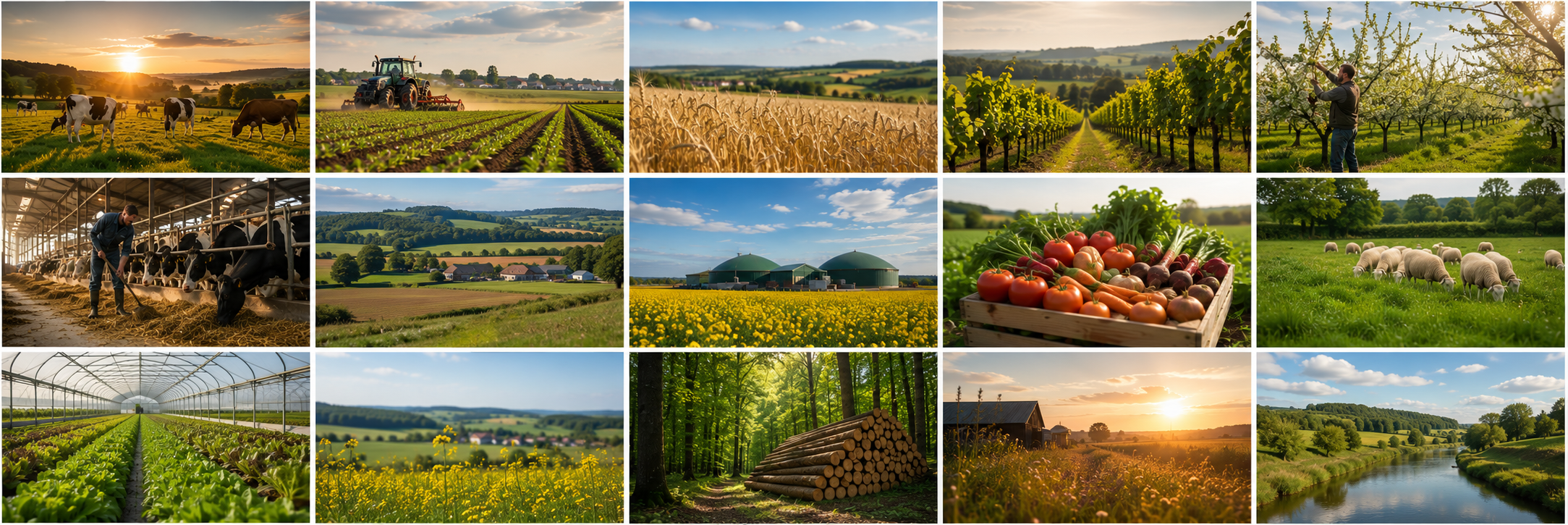
A citizen portal that translates Walloon agricultural topics into practical, verifiable and contextualized benchmarks: sectors, professions, seasons, labels, territory and food choices.
Understand, choose, share
MyAgri organises information about Walloon agriculture around clear uses: understand sectors, prepare practical steps and check terms before discussing them.
Identify productions, practical constraints and relevant actions.
Explore sectorsUse guides for visits, local purchases, workshops, orientation or projects.
View resourcesUse definitions to read an article, prepare a lesson or compare approaches.
Open glossaryRead illustrated dossiers with short chapters, reference points and verifiable sources.
View dossiersBehind a meal, there are choices of soil, weather, labor, storage and distribution. Understanding these steps helps you read a price without reducing it to the receipt.
A farm does not only occupy an area: it maintains paths, meadows, hedges, jobs and relationships with municipalities, neighbors and sectors.
Farms arbitrate between droughts, energy, investments, public rules, transmission and food demand. These trade-offs are rarely made with a single solution.
Innovation can be digital, agronomic or collective: a sensor, a more suitable variety, a processing cooperative or a new rotation can change the decision on the ground.
Markets, canteens, farm visits and purchasing groups create opportunities to ask better questions: real origin, season, remuneration, conservation and producer constraints.
Editorial method
MyAgri does not collect copied definitions. The portal rewrites, contextualises and indicates when information should be checked with a competent organisation.
Institutional definitions are used as starting points and then rewritten with local examples, limitations and verification questions.
A useful page distinguishes what is observable, what constitutes practical advice and what must be confirmed with a competent body.
Local, sustainable, organic or short circuit are not treated as absolute guarantees: each word is placed in a context of production, cost and control.
The files retain useful references, but the MyAgri text provides its own educational reading instead of copying the sources.
Maintain a regular food supply without forgetting the constraints of season, work, equipment and outlets.
Treat water, soil, climate and biodiversity as conditions of production, not as separate subjects of the farm.
Make the steps between field, workshop, transport, store, canteen or plate visible to better understand the value created.
Test tools, practices and cooperation that really improve the field, then measure their effects before generalizing.
Save and better store water to secure production.
Strengthen organic matter and limit erosion.
Deploy hedges, flower strips and ecological infrastructure.
Adapt practices and limit emissions.
Reduce costs through energy efficiency and self-production.
Better manage crops and herds using field data.
Mosaic of crops, market gardening and local processing, with close proximity to consumption areas.
Significant weight of field crops and agri-food, supported by structuring logistics infrastructures.
Livestock breeding, orchards and local value chains, with dynamic initiatives in short circuits.
Grassland systems, forests and extensive livestock farming, in landscapes where the balance between production and nature is central.
Diversity of production between large crops, livestock and market gardening, with a varied network of family farms.
Sowing, water management, protection against late frost and organization of the first harvests.
Early harvests, targeted irrigation, prevention of water stress and management of peak workloads.
Main harvests, autumn sowing, plant cover and soil preparation for winter.
Equipment maintenance, planning, animal care and preparation for the next campaign.