
Organic farming
Certified system which regulates cultivation and breeding practices, greatly reduces the use of synthetic products and imposes controlled traceability.
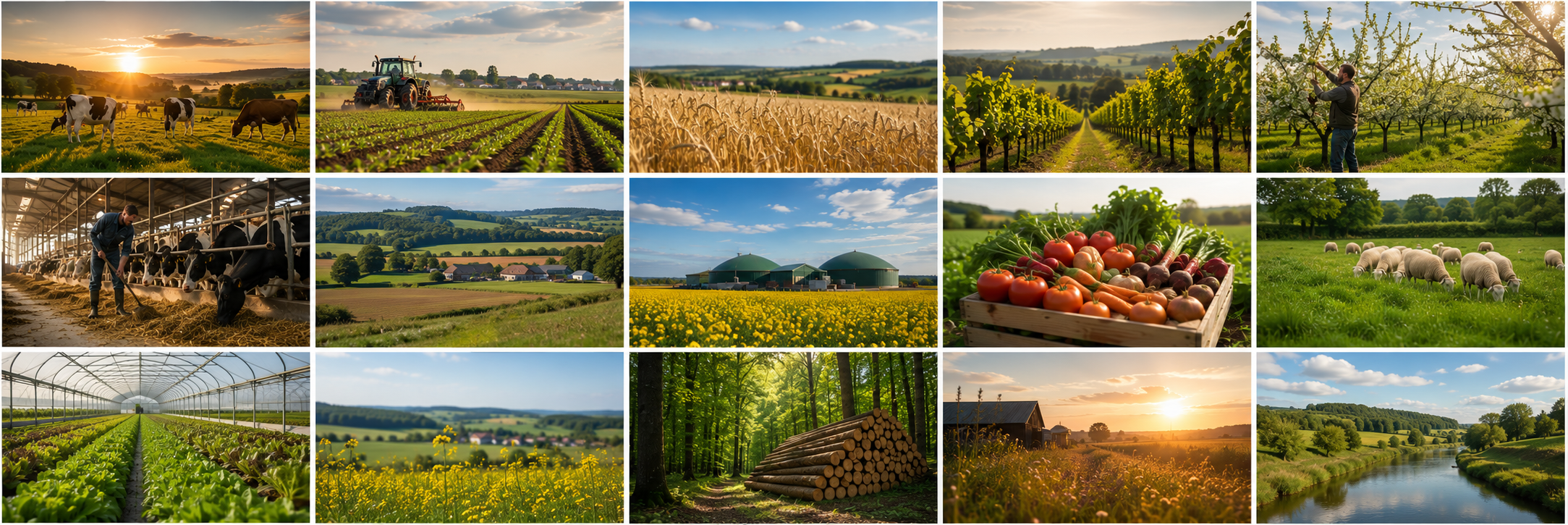
A citizen portal that translates Walloon agricultural topics into practical, verifiable and contextualized benchmarks: sectors, professions, seasons, labels, territory and food choices.
A directory of 128 terms covering agricultural sectors, field practices, public policies, territorial food and agroecological transitions.
Certified system which regulates cultivation and breeding practices, greatly reduces the use of synthetic products and imposes controlled traceability.
Way of managing a plot or a herd with field data in order to adjust doses, passages, alerts or interventions.
Conduct that favors observation, prevention and choosing the right moment for intervention before mobilizing more serious solutions.
Family of practices seeking to improve soil functioning, plant cover, useful biodiversity and the resistance of farms to shocks.
Food activities located in the city or on its outskirts, with variable functions: production, entertainment, integration, education or revegetation.
Way of designing a farm by combining production, biological balance, autonomy, diversity of practices and adaptation to the territory.
Association of trees and crops or livestock on the same plot to strengthen ecosystem services.
Supply of organic matter such as compost, manure or digestate to improve the structure of the soil, its biological life and its capacity to retain water.
Examination of a soil sample to assess pH, organic matter, nutrients and adjustment needs before fertilizing or modifying a practice.
European benchmarks of origin which link a product to a territory and to specifications, with different requirements depending on the sign concerned.
Breeding of bees to produce honey or other hive products, with an important role in pollination and reading the state of the landscape.
Distribution of different crops on the plots of a farm for a given campaign.
Capacity of a livestock farm to produce the majority of its animals’ food.
Capacity of a livestock farm or a territory to produce a significant part of the proteins necessary for animal or human food.
Organisms useful to crops, such as certain insects, birds or microorganisms, which contribute to pollination or the regulation of pests.
Area covered with grass at the edge of a plot, watercourse or path, used to limit runoff, erosion and transfer of pollutants.
Territory where rainwater converges towards the same watercourse or outlet, useful for understanding runoff, flooding and water quality.
Formation of a crust on the surface after rain, which can limit infiltration, hinder the emergence of seedlings and increase runoff.
Condition linked to an animal's living conditions: health, diet, housing, behavior, absence of avoidable suffering and quality of care.
Assessment of greenhouse gas emissions generated by an activity or sector.
Part of biodiversity which provides direct services to agriculture, such as pollination, biological regulation or improvement of soil life.
Material from living organisms, such as crop residues, wood, effluents or co-products, which can be used as energy, fertilizer or raw material.
Agricultural landscape made up of plots surrounded by hedges, favorable to biodiversity and soil protection.
Document which sets the rules to be respected for a production, a label, a certification, a transformation or a commercial relationship.
Device that measures field information, for example humidity, temperature, movement, milk production or the condition of equipment.
Control procedure attesting that a product, a farm or an organization complies with the requirements defined in a standard.
Set of temperature conditions to be maintained to preserve the health safety and quality of sensitive products.
Volume and intensity of work to be done on a farm, influenced by the season, production, labor, constraints and organization.
Sales method which reduces the number of intermediaries between producer and eater; it does not alone guarantee proximity, fair price or environmental impact.
Stabilized organic matter resulting from the controlled decomposition of plant or food waste, usable to improve the soil.
Set of requirements that beneficiaries of certain agricultural aid must respect, particularly in terms of the environment, traceability or good practices.
Agreement given to share or use certain agricultural data, with a use, a recipient and conditions that must be understandable.
Set of methods that maintain the quality and safety of food: cold, drying, fermentation, processing, packaging or date management.
Collective organization owned by its members, often used to pool processing, storage, purchasing, sales or technical services.
Crop planted between two main crops to protect and enrich the soil.
Continuous presence of vegetation on the soil to reduce erosion and improve its structure.
Crop planted between two main crops, often to produce fodder, cover the soil or enhance a short growth window.
Crop intended to feed animals, such as grass, alfalfa, corn silage, meslin or other mixtures harvested or grazed.
Simultaneous management of several species on the same plot to better use resources.
Crops planted between two main crops to cover the soil, recycle nutrients or produce biomass.
Gradual reduction in net emissions linked to the farm, through energy savings, reduced fossil dependence, carbon storage or changes in practices.
Number of animals reported on a given surface area, indicator of pressure on grasslands and resources.
Residue from methanization, which can be used as an organic fertilizer when its composition and spreading conditions are controlled.
Addition of new productions, activities or sales channels to secure farm income.
Development that evacuates excess water from damp soil, with effects to be assessed on bearing capacity, yield, biodiversity and local hydrological functioning.
Annual CAP payment linked to environmental practices or criteria defined for a given campaign and subject to conditions.
Organization that seeks to limit waste and unnecessary purchases by better reusing materials, co-products, energy or packaging.
Animal waste and associated mixtures, such as slurry, manure or manure, which can be used as fertilizer under certain conditions.
Livestock breeding system based on low animal density and high valorization of grassland areas.
Indicator estimating the volumes of water mobilized directly or indirectly to produce a good or service.
Energy production on or with the farm, for example solar, biomethane, wood energy or heat recovery, to be aligned with agricultural needs.
Method of preserving moist fodder in an airless environment, often used to feed herds outside of the grazing period.
Loss of soil particles under the action of water or wind, which can reduce the fertility of plots.
Farm where the family plays a central role in work, decisions and transmission, although it can also employ or collaborate with other people.
Cutting a meadow or forage crop to produce hay, silage or haylage, depending on weather, plant stage and needs of the herd.
Farm which welcomes the public to explain production, professions, seasons, food and links with living things.
Ability of a soil to provide water, nutrients and favorable conditions for crop growth.
Chain of actors going from production to transformation then distribution of an agricultural product.
Land available to produce, install or transmit an agricultural activity, with issues of price, lease, access, urbanization and competition of uses.
Plant food intended for livestock, consumed fresh, grazed, dried, ensiled or wrapped.
Set of practices that promote infiltration, limit runoff and secure the water available for crops.
Approach combining prevention, observation and targeted interventions to limit health damage.
Organization of consumers who pool orders with producers or suppliers, with their own rules for choice, delivery and payment.
Alignment of shrubs and trees playing a role in biodiversity, wind, water and landscapes.
Stable organic fraction of the soil contributing to its structure, fertility and water retention capacity.
Period between two main crops, during which the soil can remain bare, be covered or accommodate an intermediate crop.
Ability of several digital tools to exchange understandable data between them without unnecessary re-entry or closed format.
All products used to produce: seeds, fertilizers, protective products, energy, livestock feed, etc.
Water supply adjusted to the actual needs of the crops to optimize the resource and avoid excesses.
Soil work which turns the earth before cultivation, useful in certain contexts but to be considered with erosion, structure, energy and life of the soil.
Organization of transport, storage, packaging and deliveries which allows a product to arrive at the right place, at the right time and in good condition.
Use of living organisms or natural mechanisms to limit pests, diseases or certain imbalances.
Agri-environmental commitments generally multi-year which compensate for targeted practices, for example on meadows, hedges, soils, water or biodiversity.
Purchasing procedure used by a community to supply itself with meals or foodstuffs, with criteria that may relate to quality, origin, season or logistics.
All decomposing plant and animal residues that nourish soil life.
Biological process transforming organic matter into biogas and digestate that can be used in agriculture.
Associations between soil fungi and plant roots, which can improve access to certain nutrients and participate in the biological life of the soil.
European network of areas where certain habitats and species must be preserved, which can regulate agricultural uses without excluding any activity.
Mineral forms of nitrogen useful to plants but likely to contaminate water when present in excess or poorly controlled.
Digital, technical or methodological support which helps to choose an intervention by combining data, rules, observations and production objectives.
European framework which organizes part of the agricultural aid, obligations and guidelines, with adapted implementation by the competent authorities.
Mechanism that pays for practices producing measurable environmental benefits, such as the protection of water or biodiversity.
Method of meadow management which alternates grazed plots in order to improve grass regrowth.
Quantities lost between harvest and consumption due to storage, transport or processing.
Indicator of soil acidity or alkalinity, important for nutrient availability, biological activity and the choice of certain practices.
Programming of fertilizer inputs according to crop needs and soil characteristics.
Place where ordered or grouped products are delivered to consumers, useful for organizing local sales without a permanent store.
Transport of pollen allowing the reproduction of many plants, essential for certain fruit, vegetable and seed crops.
System that combines crops and livestock on the same farm to better exploit resources.
Sustainable meadow, useful for livestock and ecosystems.
Meadow planted for a limited period in a rotation, used to produce fodder, structure the soil or diversify the crop rotation.
Comparison indicator reducing the cost of a product to one kilogram in order to better evaluate price differences between formats and points of sale.
Full cost necessary to produce a good or service, including charges, labor, depreciation and possible losses.
Price to cover production costs and ensure a viable income for the operator.
Collective approach which organizes the food supply of a territory by linking production, processing, distribution, catering, health and local policies.
Crops rich in proteins (peas, fava beans, lupine, etc.) used in human or animal food.
Valorization approach which distinguishes a product by verifiable characteristics linked to quality, production method or origin.
Approach aimed at strengthening food production, processing, distribution and consumption on a closer territorial scale.
Quantity of water that a soil can store and return to plants, depending on its depth, texture, structure and organic matter.
Capacity of a farm to absorb a shock (climate, price, health crisis) and to continue operating.
Organization of meals served in schools, hospitals, nursing homes, businesses or administrations, with a potential role in local outlets.
Planned alternation of crops on the same plot.
Surface flow of water when rain does not infiltrate quickly enough, potentially carrying soil, nutrients or pollutants downstream.
Natural period of production of a food, influencing availability, taste, cost and environmental impact.
Monitoring the health status of a herd or animal, combining prevention, observation, care, biosecurity and collective risk management.
Technique for establishing a crop without prior plowing, which aims to reduce soil work and preserve its structure.
Carbon storage in soils and biomass, helping to mitigate climate change.
Benefits provided by ecosystems to human societies, such as pollination, water filtration, carbon storage or soil fertility.
Political and economic capacity to choose how to produce, transform, distribute and secure a territory's food supply.
Ability to keep crops, fodder, inputs or processed products on the farm, with issues of quality, safety, cost and sales schedule.
Situation where crop water requirements exceed availability, affecting yield and quality.
Local organization linking production, processing, distribution, consumption, waste, public actors and citizens around food.
Synthetic view of farm or sector indicators, useful if the data is reliable, up-to-date and linked to concrete decisions.
Compression of the soil by passages, weight or wet conditions, reducing porosity, rooting, infiltration and ease of work.
Practices reducing the intensity of tillage compared to plowing, in order to limit erosion, preserve the structure and reduce certain costs.
Ability to track a product from its origin to its sale using verifiable information.
Promotion of production directly on the farm (cheese, juice, yogurt, etc.).
Path of change that combines technical tests, economic viability, working conditions, reduction of dependencies and measurable effects on living things.
All mechanical interventions on the land, from plowing to direct sowing, chosen according to objective, soil, weather, culture and risk of erosion.
Comparison benchmark which expresses different livestock in a common unit in order to evaluate loading, surface areas or forage needs.
Wealth created by the processing, quality, origin or method of marketing of a product.
Variety selected to better tolerate a given disease, stress or condition, without completely eliminating the need for observation.
Marketing of a product from the producer to the consumer without a commercial intermediary, on the farm, at the market, at a relay point or online.
Orchard composed of tall fruit trees, often associated with meadows, traditional landscapes, biodiversity and extensive production.
Walloon digital platform which facilitates the secure exchange of agricultural data between tools, farmers and authorized partners.
Objective of land sobriety: reduce the extension of built or waterproofed areas and compensate for losses when the rules provide for it.
Space where water has a lasting influence on the soil, vegetation and uses, with functions for biodiversity, water storage and environmental quality.
Space developed between an agricultural activity and a sensitive environment to reduce the transfer of pollutants, protect water or preserve biodiversity.