
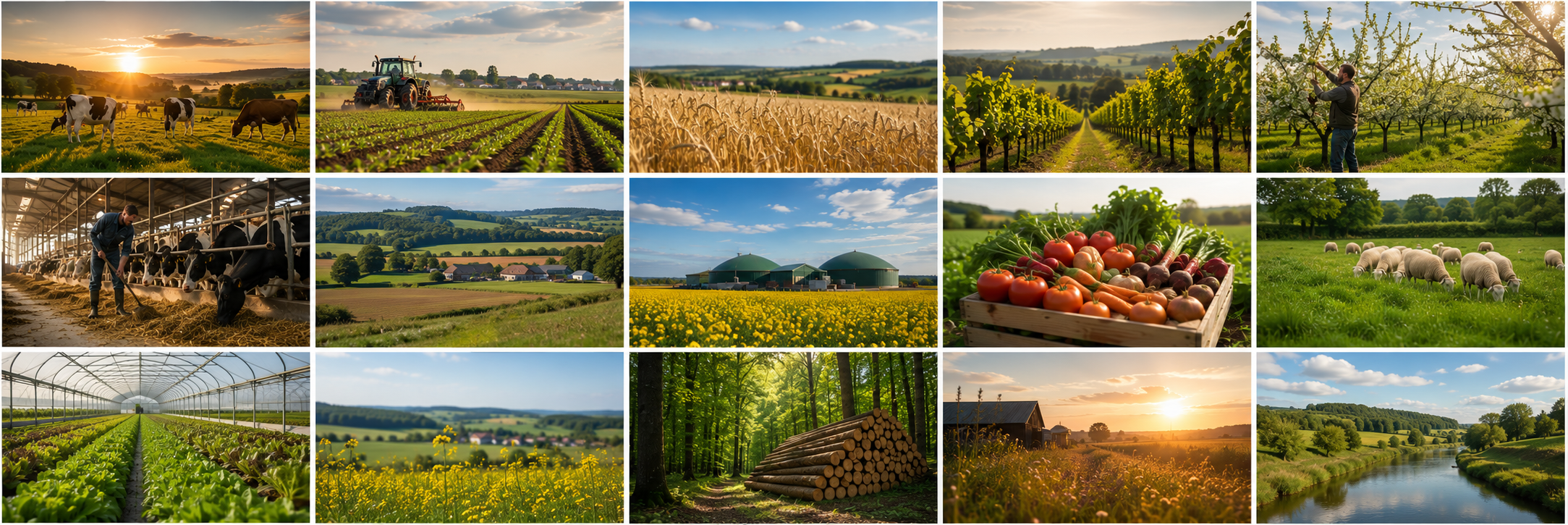
Walloon agricultural landscape illustrating the MyAgri citizen portal

MyAgri — Walloon agriculture explained

A citizen portal that translates Walloon agricultural topics into practical, verifiable and contextualized benchmarks: sectors, professions, seasons, labels, territory and food choices.

Updated on 27 June 2026 · Wallonia, Belgium

← Back to resources

Educational visits

Find farms open to the public and schools.

Prepare a farm visit with a clear objective, safe instructions and useful feedback for the group.

Target audience: Schools, youth associations, neighborhood centers, cultural centers, families, nature and community leaders.
General introduction

A farm visit should not be limited to a pleasant outing. It becomes useful when the group knows what it is coming to observe, what rules to respect, what questions to ask and how to reuse what has been seen.

The proposed content therefore helps to prepare ahead of time, secure time on site and transform the visit into a usable educational trace.

Prepare the exit in advance

  • Define a learning objective per group (seasonality, professions, production, land-food link).
  • Choose a farm suitable for the public by controlling accessibility, reception capacity, hygiene and safety.
  • Define the roles of adults: reception, supervision, animation, note-taking.
  • Retrieve parental authorizations, health consents and emergency contacts.
  • Plan transport, schedules, breaks, fallback weather and rescue.

Design the process

A stable sequence follows five stages: introduction, observation, practice, synthesis, extension. Each time remains short, predictable and leaves room for questions.

Drive there

  • Start with the safety rules and the traffic plan.
  • Facilitate guided observations and simple manipulations according to age.
  • Alternate short explanation and discovery in action.
  • Note the points of collective interest for the final restitution.
  • Close with a mini-summary of learnings.

Continue after the visit

  • Share a 5-minute report with a central concept + a useful discovery.
  • Keep photos, notes and materials for use in class or in the workshop.
  • Propose a creative restitution: poster, notebook, audio capsule.
  • Measure your achievements with a before/after mini-questionnaire.
  • Reserve an improvement point for the next outing.

Recommended steps

  • Step 1 — Clarify the educational objectives and the target audience.
  • Step 2 — Choose the farm by validating security, access and reception conditions.
  • Step 3 — Build a process in co-construction with partners.
  • Step 4 — Finalize authorizations, logistics, roles and materials.
  • Step 5 — Communicate the rules and expectations to the group.
  • Step 6 — Spread the visit into active, short activities.
  • Step 7 — Restore and capitalize on learning.
  • Step 8 — Evaluate and record areas for improvement.

Practical checklist

  • Educational objectives defined and shared.
  • Sufficient adult supervision depending on the age of the group.
  • Authorizations and health records present.
  • Safety instructions explained and reminded.
  • Transport and emergency plan verified.
  • Prepared field supports (sheets, quizzes, notebook).
  • Method of restitution and evaluation planned.

Learning objectives

  • Understand the food production cycle from field to plate.
  • Identify the role of soil, water, biodiversity and climate.
  • Discover agricultural professions and their functions.
  • Differentiate between local production, processing and distribution.
  • Develop a critical view of labels, origin and cost.

Recommended programme

  • 00:00-00:10 — Reception and rules.
  • 00:10-00:40 — Field tour: production, buildings, animals, soil.
  • 00:40-01:10 — Workshops and guided manipulations.
  • 01:10-01:25 — Break and check notes.
  • 01:25-01:50 — Focus “from farm to fork”.
  • 01:50-02:00 — Final restitution and extension.

Adaptation by audience age

  • Kindergarten: sensory journey and short instructions.
  • Primary: guided observation, simple manipulations, visuals.
  • Secondary: argumentation, data, debates.
  • Adults/families: consumption link, budget, quality, seasonality.

Examples of learning activities

  • “Recognizing crops” workshop (leaves, seeds, smells).
  • Mini-survey: “what happens to a food from the farm to your plate?” »
  • Producer/transformer/distributor/consumer role play.
  • Simple measurement of soil texture, coverage and water retention.
  • Anti-waste cooking workshop with seasonal products.

Prevention and safety

  • Prohibition zone around sensitive machines and animals.
  • Wash hands before and after each handling.
  • Reinforced supervision at risk points.
  • Interior fallback plan in case of rain or heat.
  • Management of allergies and dietary restrictions confirmed.

Budget items to plan

  • Transport (car, carpooling, public transport).
  • Welcome and farm entertainment package.
  • Educational materials: sheets, printouts, supplies.
  • Field equipment: gloves, overshoes, cleaning.
  • Unexpected margin (10 to 15%).

Evaluation method

  • Before/after questionnaire to memorize learning.
  • Collective output: posters, audio, logbook.
  • Self-assessment of participants.
  • Feedback from the operator and points for improvement.
  • Organizing report: lessons learned + recommended follow-up.

Check before acting

Educational visits provides practical guidance. Before making a binding decision, document sources, costs, local constraints and people consulted.

  • Does the farm confirm schedules, access, sanitation, prohibited areas, allergies and instructions around animals or machines?
  • What learning objective will be verified after the visit, and with what restitution support?
  • Which photos, notes or productions can be kept without authorization problems?

Questions about this resource